

The opening montage of the biographical drama, written and directed by Sofia Coppola, Priscilla is a dreamy, blanket of idolization. Idolization of an abusive man. Idolization of a golden cage. Idolization of trapped beauty. The romantic montage consists of the daily cosmetic rituals performed by the woman herself. The quick presentation of Priscilla Presley in slight vulnerability allows for a myriad of possibilities in the film to be created. So on November 3rd, 2023 (the widespread movie release date), the audience observes as Priscilla Presley leans into her mirror, adjusting her false lashes, effectively leaving the theatergoers conflicted. Why is this iconic figure’s biopic appearing to look like the first scene of a familiar teeny-bopper movie or a lighthearted rom-com?
What could it be? Many versions exist of the man that often is used to describe her fame. A man who’s influence on music is too vast to be put into words. Elvis Presley was, in many ways, the epicenter to Priscilla’s girlhood, and therefore, a centerpiece to the film.
Is this a biopic centered around the caricature with whom she shares a last name? A romance centered around the young love she shared with the King of Rock n Roll? A heart-breaking story depicting the drugs/sex/rock n roll themed rollercoaster she was thrown into at an age she should have been playing hopscotch? Least of all expected out of the biopic is a portrayal of quiet existence followed by quiet defiance.
Priscilla is a glossy reverberation of the tumultuous relationship between Priscilla and Elvis Presley. The film follows a young army brat in Germany, Priscilla Beauliu, while at the same time, international rock star-turned-draftee is deployed to Frankfurt. Priscilla is scouted by a friend of Elvis’s, a fellow American soldier deployed to the loneliness of a foreign country, while doing her homework at the popular “Eagles Club” where most Americans went to eat, listen to the jukebox, or socialize. She eventually meets the famed figure at one of his subdued parties, after which, Prisilla, her parents, as well as Elvis’s friends and family, are shocked to find he would like to continue seeing the fourteen-year-old girl. The picture follows her story as she falls in love with the powerful man as he slowly loses his revered fame along with his patience for any oppositions and she slowly loses her child-like innocence and naivety.
This film epitomizes what it means to emerge from teenage oblivion. This film defines the frilly, whirlwind of life experienced by the teenage girl-turned-child bride and her fight to slowly grow out of the mold that solidified around her at just fourteen years old, a process that is showcased through her clothing choices that ebb and flow, subject to a multitude of judgements, as well as a symbolization of her maturity, or the maturity she wants to be perceived as having, dialogue that Sofia Coppola carefully picked out from the original book (written by Priscilla Presley herself), and music that defines the meaning behind what is not said. The film shows her journey from an ornament to an independent being.
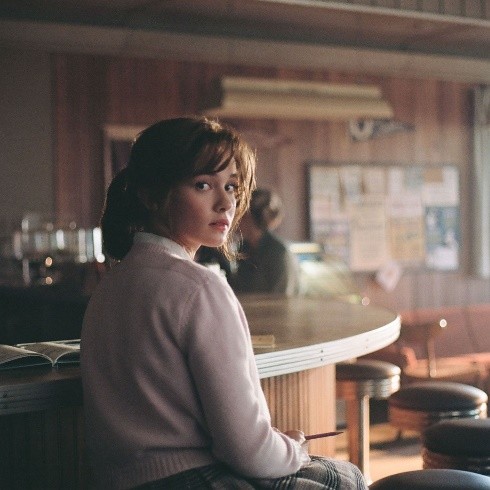
The first scene of substance after the opening montage is a scene of fourteen-year-old Priscilla sipping on a milkshake while doing her ninth-grade homework. She is dowsed in gauzy light, the picture of innocence, represented by the white clothing and light colors that she primarily wears while still in Germany. Her natural brown hair is pulled back in a bouffant with her bangs sweeping across her forehead. Her white clothing specifically represents the natural purity she keeps in her and Elvis’s bubble away from American pop culture. And she is still somewhat considered a child, from being around her parents to residing in her childhood home. This purity is a defining quality of Elvis’s attraction to her.
There’s a compilation of songs throughout the film, thoroughly chosen by Randall Poster and Thomas Mars (lead singer of the band Phoenix), that represent the continuous dreamy, isolated aesthetic that is Sofia Coppola’s signature. For example, Crimson and Clover by Tommy James and the Shondelles, allow the scene of Priscilla meeting Elvis for the first time in Germany to feel romantic rather than predatory.
When Priscilla arrives at his Frankfurt home in her easter dress (another symbol of her immaturity, the soldier who brought her introduced her to Elvis. Elvis’s first question was what grade she was in, his assumption being 11th or 12th, but when she noted that she was only a freshman in high school, he replied with, “Why, you’re just a baby.” This subtle connotation is something that would have humanized him because, she is a baby. She’s fourteen, he’s twenty four. At his next request for her presence the audience is able to discern that his wishes are more than friendly.
The band, Phoenix created the score for the film, which varies from high strung electricity to nimble notes of loneliness. This score is perpetually, perfectly, in a state of misplaced modernity. This feeling of misplacement allows the audience to perceive the story in an unpredicted manner, making the characters more relatable through its modern feel. I recognize Priscilla’s shyness in my friends more, the way she holds back around new people and puts extreme importance in her appearance, because of this stylistic choice. It helps the audience to see that she is emotionally and intellectually equal to their daughter, sister, or granddaughter.
Priscilla’s fashion choices are sometimes flaunted- sometimes simply existing, changing in alignment to her journey from adolescence. Throughout the picture, the audience watches her go through phases: forced maturity, controlled style, and finally- finding out for herself what type of clothes she prefers to put on her own body. She is consistently changing her appearances to align with others’ expectations.
As we perceive Priscilla’s transition into maturity that is on display rather than intellectually developed, she transforms into a doll that Elvis can customize. After she moves to Graceland, Elvis takes her shopping (with his disciple-adjacent entourage), the lot of them manspreading on the couch while she prances around in different outfits, waiting for Elvis’s compliments and criticisms. This is also when the audience is able to observe her dramatic change in makeup and hair. What was once a natural brown hair color is now jet black to match Elvis, as well as a new dark and smoky makeup look.
“No brown, it reminds me of the Army.” “You’re a small girl. You’ve got to keep away from the prints, baby.” These demands that were made to a then sixteen-year-old immediately impose a sense of dominance. It is these demands that restrict her intellectual freedom through their quiet rejection of individuality. She must confine herself to the rules written for her, instead of exploring what every teenage girl enjoys. Expressing herself through her appearance. Eventually, Priscilla learns that she is able to defy these rules set for her and decide which battles she considers the most important to fight.
The first argument between the couple- and her first act of defiance is when Priscilla walks into his room in a warm colored, puffy, patterned dress. Elvis demeans her, laughing at her when she expresses emotion, making her think also, that her thinking to hold an opinion in opposition to his, is quite hilarious. This particular expression of hilarity amplifies the obvious power dynamic between the couple. He has everything, she could be sent back home at the snap of his fingers.
When she unexpectedly arrives in Los Angeles during their pre-marriage days, she is angry at the fact that her boyfriend is prancing around scandalously in the tabloids with Anne-Margret. The printed dress she shows up in is her reaction to these circumstances; she expresses her repressed resentment through her subtle- yet deliberate actions because it was absolutely unthinkable that she actually voices her disappointments. This miniscule act of defiance takes place inside the slightly pathetic form of wearing clothes that go unregulated by her man. The audience is able to notice a slight, but visible change in the way she presents herself, although she soon learns the effects of expressing herself, or her opinions.
Elvis’s violent outbursts are the result of anytime Priscilla voices her opinion or expresses any form of negativity. These outbursts, verbal abuse, sometimes escalate and slowly become a pattern. He shouts at her, sometimes throwing things, even when her opinion is explicitly requested. When Prisicilla is in the room while Elvis and his entourage are judging demo soundtracks of his upcoming, low-quality movies, it is obvious that he is deeply frustrated with the direction of his career. He whines, asking “When are they gonna send me a godd*mn decent song?”. He looks to Priscilla, “Cilla, what do you think?” She looks up, eyes wide, surprised to be addressed in such a full room, surprised to be addressed by her first name, nonetheless.
“I don’t know if I like it.” She murmurs softly, looking down.
This statement is barely on the brink of being an opinion, more of a question rather than an expression of distaste. But this throws Mr. Presley into a rage. Before she finishes her next sentence, he picks up the chair in front of him and hurls it at the wall behind her head. She cowers into a kneel, shaking in fear while Elvis immediately goes to her side in repentance. This upsetting scene puts the effects of Elvis’s capricious, raving temper on display. The audience is meant to be shocked at her calm reaction to this tantrum, because it shows that she believes this situation is normal, that she is used to the required submissiveness.
Note that he also calls her by her nickname so close to her real name, when asking for her opinion, showing that maybe he actually sees her as an equal rather than a pet, in stark contrast to when she shuts her mouth and shows her fright, making herself small, he perceives her as something to be dominated. In his apology, he also switches back to her former, infantilizing nickname, “I’m sorry baby.”
The audience watches these “sorrys” cut it for approximately fifteen years, fight after fight, scandal after scandal, until Mrs. Presley announced her divorce. The announcement is only slightly jarring to viewers because, of course, it isn’t a question that she must leave, yet who is she without the people and the place that she came of age around? Who is Priscilla Presley without Elvis? Perhaps the most obvious clue to Priscilla’s development as her own person occurs when Elvis asks her why she is leaving and if it’s because she met someone else. Her reply exudes the exhaustion, the repression she bore for years of her adolescence and part of her young adulthood.
“You’re losing me to a life of my own.”
Sofia Coppola wanted to allow the visual details to tell the story, keeping dialogue minimal and precious when delivered. Sofia often resorts to quick shots of the objects surrounding her characters rather than closeups of their features. Priscilla is shown as a soft, conflicted young woman in how she speaks, her change in appearance, and her ability to adhere to the context that Elvis demanded. Her immaturity is on display within the camera shots of her slightly messy bedroom, beauty products strewn around.
Elvis is perceived more as a spoiled child in an adult’s body rather than a grown adult with autonomy over his own behavior, actions, and relationships. His temper tantrums resemble a toddler’s, not a powerful celebrity. The manipulative tactics he employs against Prisicilla may not be consciously malicious, but instead, natural. Coppola purposely makes his behavior more open to analysis in the film because the usual awe of his artistry is tamped down. There’s not a single Elvis song in the film.
The closing scene of the film is one deeply steeped in irony. It occurs directly after Priscilla gives her goodbyes to the friendly faces at Graceland, and gets into her luxury sedan. As she drives down the street, Dolly Parton’s I Will Always Love You, begins to play.
The famed singer’s voice wilts over the engine, “If I should stay/I would only be in your way”, alluding to the somewhat misinterpreted fact that Priscilla was “in [Elvis’s] way”. Priscilla, who did nothing but provide endless support to all her husband’s haphazard creative endeavors, who stood by watching her own life’s purpose become sedated, simply because she was devoted to the man she loved since she was fourteen years old.
This film provides both the dream of a teenage girl marrying the rock n roller who’s records she once fanned over and how she overcame being accustomed to physical and mental abuse starting from adolescence. Because of course, no fourteen-year-old girl in 1959 would have rejected Elvis Presley, yet that is exactly why the relationship never should have occurred. Currently, there is a strict societal expectation that celebrities are not to have a romantic relationship with their fans, as it creates a huge power gap that results in a loss of consent and individuality. As well as the obvious widespread disgust at the corrupting and manipulating of a minor.
This relationship, accumulated in Sofia Coppola’s creative eye, shows an aesthetic of a beautiful prisoner in a golden cage. All the while, Coppola is able to hold on to the purpose of the film, shining a light on Priscilla’s journey, not demonizing Elvis. The movie shows how she overcame his demands, not why he gave them in the first place.
The process of Priscilla finding her own interests and relationships formed the independence of the young woman who came of age in a place where her only purpose was to serve a man who was constantly reminding her that she was replaceable through both outright threats and sly comments. Her isolation and assigned inferiority is made digestible through costumes that serve direct purposes in portraying a development of the mind from childhood to womanhood, the act of choosing her own clothes a state of liberation and rebellion, thoughtful dialogue that could tell a story even when reduced from life, to book, to movie, and music that takes the audience on a voyage, cultivating exactly what feeling is omitted from each scene. These elements of the film ultimately allow the famous couple to be viewed in a raw lens and in a prettier form.
As Priscilla drives out of Graceland, leaving for California, the audience is left reeling. The movie fades to black just as she exits the infamous property’s gates. Her own biopic ends just as she is finally freed from the constraining chains of what had been her most formulative years, begging the question: who is she when lacking a state of confinement?




Araiza Del Toro Amaya • Jun 3, 2026 at 9:01 pm
Yes, I loved this review!! I also think it’s so heartbreaking when Elvis acknowledges himself that’s she is “just a baby”… To me it seems like he is trying to validate the situation for himself and take advantage of such a young girl… Also I never gave much thoughts to the outfits she wore and how that changes throughout, the story does a great job of showing that transition!!
– DelToroAmaya.A143 @ student.cbsd.org
Sofie • Jun 1, 2026 at 7:45 am
This was a really interesting read. Great Job!